November 13, 2011

Digi: Buying up to RM35.00?

Are people really lining up to buy Digi shares before it goes ex on 21 November?


If so, what are their possible logical reasons?

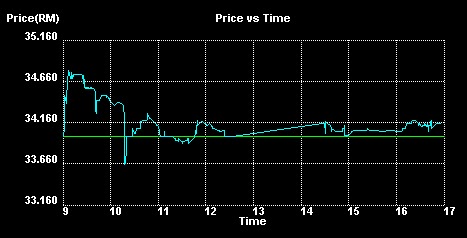
Right now, Digi shares are skirting below the RM34.50 price divide.  The highest it did was RM34.54 about a hour ago. It has touched RM35.00 in earlier trading sessions. Will it once again touch RM35.00 or even go beyond in the next few days?

At noon, Digi shares closed at RM34.52 with plenty of buyers in tow at RM34.50. It gained 74 sen at half day trading halt. Market willing,it appears that the shares might just end at or above RM34.50 today. As expected, it ended at RM34.52 with a gain of 74 sen intact even though it breached RM34.56 at one point.


At the recent EGM, the Chairman said that the shareholding spread is very small as Digi itself holds 49% of it. They intend to buy some more once the government approves the liberalized framework and that could be sooner that we can expect.

Anticipating this, I am sure punters are picking up Digi stocks and friendly parties could also be accumulating. Once the shares go ex;say at RM3,50; that will allow more minority shareholders like the man in the street to procure shares in trading lots of 100s and 200s to share in the growing story of Digi. And that may also trigger institutions from both external and internal to start mopping loose split lots.

My take is it will be a matter of time before Telenor buys into the market. That will tighten the share-spread once more to propel Digi shares  to go beyond possibly RM4.00.

I also believe Digi will also be having a 10% share buy back facility at the next AGM in 2012.

We await for this kind of scenario to unfold before 2011 ends.

November 11, 2011

Digi:Can I have a bigger slice?


Can I have a bigger slice?

Telenor ASA, the largest phone company in the Nordic region, is in talks with the Malaysian government about raising its stake in DiGi.Com Bhd.

The interest comes about four years after it sold some shares to comply with a foreign ownership cap for the industry. It now owns 49 per cent of DiGi.

“In all the meetings with the government, we are asking: When will the telecommunications industry be liberalised or when will they take up the threshold for foreign ownership?” said Telenor Asia chief executive officer Sigve Brekke in a Business Times interview.

“We always urged the government to reconsider the ceiling for foreign ownership, and if that ever happens, we would then be considering if we should increase our stake,” he added.

Under the 2012 Budget, the government proposed that 17 services sub-sectors, including telecommunications, be liberalised in order to attract more foreign direct investments.

Telenor used to have 61 per cent of DiGi but sold a 10.2 per cent stake to Time dotCom Bhd (TdC) in 2007 to comply with the foreign shareholding rule. It sold the shares for RM1.61 billion.

Brekke, who is also the chairman of DiGi, said opening up foreign ownership of the telecommunications sector would ultimately benefit consumers.

“By opening up the sector, it will encourage more investments into the country, and also create better competition in the industry,and that means providing cheaper and better services to the people,” he said.


Telenor bought a minority stake in Digi.Com in 1999 and two years later raised it to a majority. The Norwegian government is the major owner of Telenor with a 54 per cent stake.


Digi closed down 22 sen to RM33.78 today 

So, are you picking up any Digi when it goes ex-split on 23 November 2011?

November 10, 2011

Digi: A Halt to the Summit

Today, Europe launched another stinker of a bugbear.


This time it is Italy. The PM has called it quits. The economy is fast stalling and the government may not be able to be liquid enough to pay its impending debts. So, bond prices in Italy went beyond the so-called unsustainable 7% level.

Pandemonium struck again at most global markets erasing recent gains as fears abound about the potential break up of the Euro currency market.

Bursa KL is also not spared, losing 17 points currently.

For Digi, it is as good a time to take that much needed rest.

Falling to RM33.90 at one point, Digi is now trading in crimson waters just above the RM34.00 level.


The likelihood is Digi will end in red waters. And so it did, at RM34.00 for a 16 sen loss.

November 09, 2011

Wilmar Rides the Storm


Wilmar International (Wilmar) is confident that higher prices will support its palm oil and sugar businesses though it underperformed missing earnings expectations. However, there is solace-net profit jumped almost 24 per cent jump compared to the earlier year.


Moreover,Wilmar’s lower-than-expected earnings were linked to a foreign exchange loss and weaker margins from its consumer product business as the rise in cost of feedstock outpaced the price increase.

Interestingly, Wilmar’s results compared  favourably when benchmarked to world giants such as Cargill and Bunge with the former losing some 66 per centof its earnings of US agribusiness. 

Bunge, the world’s largest oilseed processor and among the top sugar and ethanol producers,saw its earnings declined by a third.

Wilmar remains positive of its prospects, despite uncertainties in the global economy, due to the resilience in the demand for agricultural commodities and the continued growth of Asian economies as palm and laurics will benefit from the recent changes in the Indonesian export duty structure for palm products, which it said is highly advantageous for downstream processing margins.

The company has about one third of its total crude palm oil (CPO) refining capacity in Indonesia, Macquarie said in a research note, adding current CPO price could give Wilmar a potential uplift of US$104 (RM324) per tonne in Indonesian refining margins.

The world’s largest listed palm oil plantation firm, which generated more than half of its revenue from China, partly benefited from an increase in its cooking oil selling price by 5 per cent in China earlier this year.

Wilmar did caution that consumer product margins in the third quarter were still lower from a year earlier due to bigger increase in cost of edible oils feedstock, while the group had only about one month of price increase benefit in China. Wilmar was allowed to increase its price for consumer products in China on August 1.

The company, which owns palm oil plantations in Indonesia and Malaysia as well as sugar operations in Australia, earned a net profit of US$321.05 million for the quarter ended September 30, compared to US$259.5 million earned a year ago. That compares to an average forecast of US$461 million from five analysts.

Excluding the exceptional items, the company recorded a net profit of US$442.4 million compared to US$172.4 million a year ago.

Its earnings in the second half of 2010 were hit by losses from its oilseeds and grains business, which the company blamed on weak margins and inopportune buying.

Wilmar’s share price has declined by 0.7 per cent since the start of this year, compared to 10 per cent fall in the broader Singapore market. 

So, will PPB see more dividends from Wilmar this year?

November 08, 2011

D-Day Digi to Go Ex

Was there a push or was it a genuine buyer at RM34.80? That we may never know for sure.


What I saw in the morning session before the EGM scheduled at 2 pm is that buying pressure has receded and bargain hunters are stacking up; pulling prices down. Most stock were done in the RM34.60-RM34.70 price range.

By 11 am, the price of the stock has dipped below RM34.00 for the second time falling as much as 34 sen at once instance.

Now it is just playing limbo rock below the RM34.00 price level and sitting at the price plateau of RM34.00 and some occasional price spurts  has brought it to positive territory.

Let us see how it will settle down at  the 12.30 trading break.


Looking back,it can be seen that confidence in the stock stayed at an upbeat bias as the stock transcended the psychological RM34.00 mark. Subsequently it see-sawed between RM34.04 and RM34.16 finishing at at RM34.16 for another 16 sen gain. Paltry but significant as the stock has now been approved for splitting.

Ass the time-table goes, the share will go ex on 21 November. Those shareholders who are on the company's register at 5 pm on 23 November will get the divided shares into their respective CDS by day-end.

After that, it will be dependent on market forces and perception of the historical RM0.01 sen share may give Digi a brand new image at the single ringgit league once more.

Let's look forward to Thursday 24 November 2011.

Hitting RM34

Somehow I have a gut feeling that someone is benchmarking the stock price of Digi before the split.


Some stock analyst had forecasted that Digi will go ex at RM3.40. So true to form, it burst the banks and headed beyond to RM34.22; pulling back comfortably to perched at RM34.00 at the day's close. As far as the mission is concerned, they did their job pretty well as the price breached RM34.00.

Anything more will be on its own steam.

Tomorrow, at the EGM, the share will  officially be endorsed for a share split from its current 10 sen par to become a 1 sen par share. Theoretically, based on today's price, the price of RM3.40 per share brings a honourable premium of RM3.39 sen.

So let us see the price trajectory of this counter until Digi ex-split at the end of November.

Fantastic!

YTL Corp-Excitingly mischievous

 On  the GLC-Non GLC divide, one company continue to up-end almost everyone.

Perhaps Robert Kuok'e empire rule supreme. Perhaps Genting Highland Group is a formidable adversary.

But right there before our very eyes-there is the looming YTL Group helmed by the founder and his financially savvy son.


I was just looking at the reserves and cash in hand of YTL in their latest Annual report 2011 posted on Bursa KL's website this morning.

What I found interesting is that the reserves have been rising rapidly even more dramatic than the current flood waters in Bangkok.

Up to mid-2011,the fixed deposit of YTL has risen by another RM971 million since 2010. Extrapolating forward, before the year is out, additional fixed deposit should have crossed the RM1.2 billion mark by then

Combining deposit and cash in hand and bank balance, the total amount at the disposal of YTL stands close to RM12.24 billion as at mid 2011; and that my friend, is plenty of mucho dinero.

So what does a cash rich company do? Waste it as inflation devour its value? No, besides hedging it against currencies and other investment such as gold , it must do sometime about the cash horde.

As the say, an idle cash horde is a devil's playground and so good old Francis is watching out on how to make more money and more money.

What do you think he can do?

Well, for one-he is waiting for the green-light to build the KL-Singapore high speed train.  Then there is always the next phase for his 4G telephony trajectory. As YTL Corp has sold most of its real estate to STAREIT or to YTL Land and Development, it is now a plenary company for strategic takeovers and tactical pursuits.

In the meanwhile,since its Treasury share accumulation is closing to the 7% mark, it may just distribute the shares generously to its loyal shareholders and start accumulating again once they obtain the renewal from its shareholders on 29 November.

The current share price is RM1.50- about the same price when it share split from 1 to 5 shares.

All in all, YTL Corp is proving to be one interesting company to watch.